
SpeedFit™ Design Simulator
Simulate and evaluate the performance of SiC-based power circuits and determine the right SiC device in seconds.
Start a SimulationTemperature monitoring of switching cell

Hello,
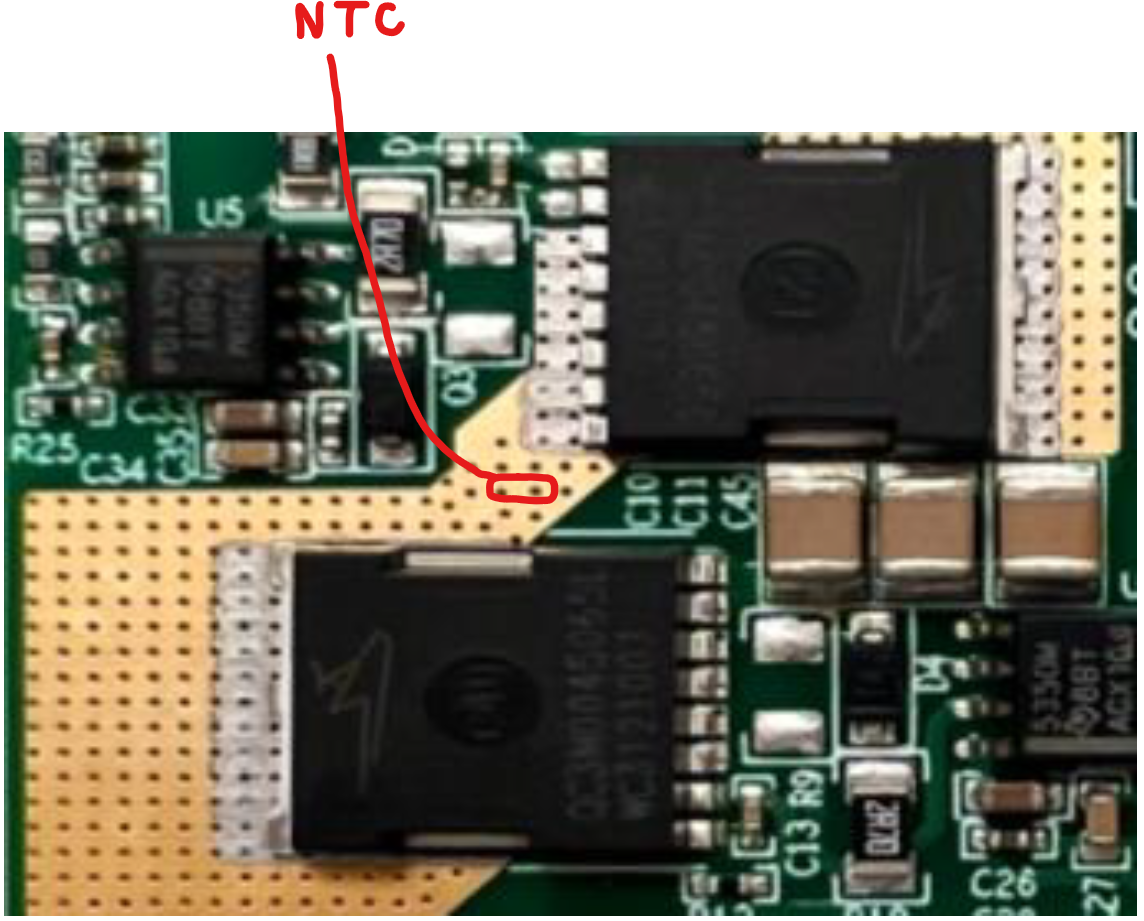
I'd like to use a single thermistor to read the temperature of my switching cell. I know it won't exactly reflect either junction temperature, but hoping it will at least sense the "general" area of the cell. If the SiC FETs are arranged in a side-by-side configuration like that shown in PRD-06752 (snipped below), then I would expect that both FETs are somewhat thermally coupled together to the switch-node. Since the high-side PSU is referenced to the switch node, would it make sense to power an isolated amp+thermistor circuit on that same PSU, and just attach the thermistor to the switch node? I will be using Wolfspeed SiC FETs which have the Kelvin-Source pin, so I think I would have to protect the iso amp's inputs from any dv/dt transients that might occur between Kelvin and Source pins. I will only sample temperature during "quiet" windows of the switching period. I'd greatly appreciate any feedback on this. Is this a bad idea?
Thanks!
Zackary Long
Comments
-
Thank you for your post, it has been approved and we will respond as soon as possible.
0 -
Hello Zackary,
Since heat must travel from the die through the device pins to the copper pour, the thermistor will not be a good tool for estimating the device junction temperature. Sometimes, a thermistor measurement can vary significantly from junction temperatures, and it cannot capture transient thermal behavior. Section 4 of PRD-08376 discusses this in more detail for power modules (which has similar principles to your configuration).
Recognizing this limitation (which is sounds like you are already aware of), it can still be useful to integrate a thermistor measurement. It does make sense to power isolated circuitry off the same isolated power supply unit (PSU) that is used for driving the relevant MOSFET. However, you'll need to make sure the isolated operational amplifier (Op Amp) has a suitable isolation rating for your application. Section 3.4 of PRD-09301 goes into more detail about some of the different isolated feedback approaches for thermistor measurements. That application note is written for power modules, where the thermistor is typically electrically isolated from the any of the voltage nodes, but the concepts are the same regardless. The easiest feedback approach is to use a gate driver integrated circuit (IC) with an integrated analog feedback pin such as the Texas Instrument UCC21710, though this is not an option in all cases. The PRD-09301 application note provides some alternative options such as using an isolated OP Amp as you indicated.
When possible, we recommend referencing a thermistor measurement to the low-side source for better noise immunity, though it doesn't sound like that makes sense for your application. Since thermistor time constants are very slow compared to the electrical switching dynamics, we recommend applying an aggressive low-pass filter to the thermistor measurement to damp switching dynamics. This should enable you to perform the required measurement even when referenced to the switching node.
Thanks,
Chris N.0 -
Hello Zackary,
I hope that answered your question. I will close this discussion for now but if you have a follow up question, please "Start a New Discussion" and we would be glad to support you further.
Thanks,
Chris N.
0